

1
Materials
Foams
Polymer foams are plastics with a cellular structure. This structure gives the materials a low density, high elasticity, good damping properties and excellent heat and sound insulation. This is why polymer foams are used in the automotive industry (e.g. for lightweight components, shock absorbers and seat upholstery), in the construction industry (e.g. as thermal insulation) and in the packaging industry (e.g. as protective packaging for sensitive goods). They are also used in medical technology, in the sports and leisure sector and in the aerospace industry thanks to their combination of strength and lightness. Our broad expertise in the field of polymer foams enables us to develop new materials and processing technologies in a targeted manner.
Competencies
Material and process development from laboratory to prototype scale
Development of technical foams
Bio-based and biodegradable foams
Characterization of processing, morphology and properties
Use of digital methods in development
Materials overview

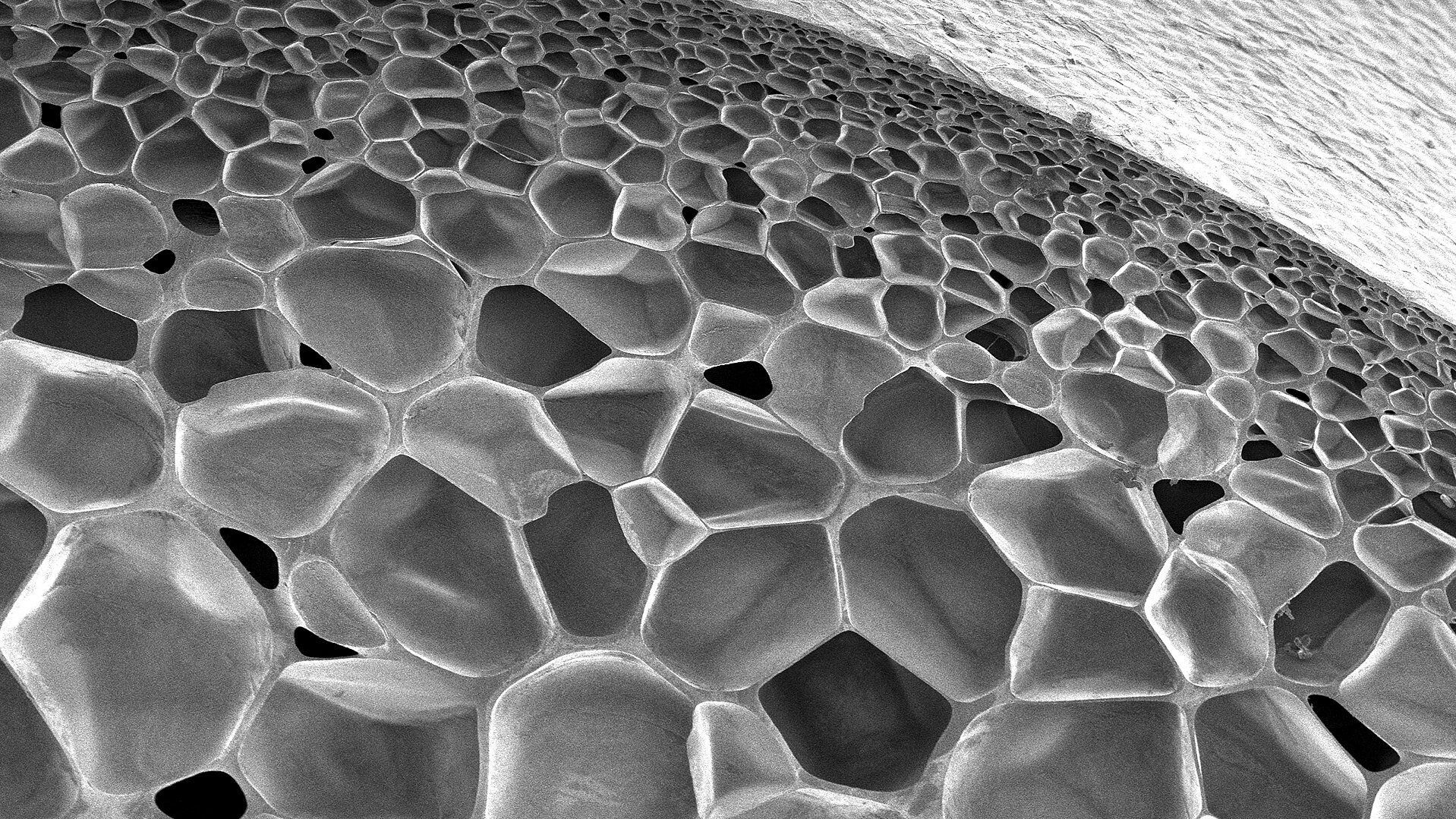
Foam structure of a particle foam bead under the scanning electron microscope (SEM).
Particle foams
Particle foams or bead foams consist of expanded thermoplastic beads that are welded together to form molded parts. Compared to other foamed plastics, particle foams offer the decisive advantage that very complex, three-dimensional structures with densities from less than 20 kg/m³ to over 300 kg/m³ can be can be manufactured as a near-net-shape component. This freedom of design, combined with the broadly adaptable density, makes particle foams the preferred choice in numerous applications - from packaging and the automotive industry to sports and leisure products. For many years, the development of particle foams has mainly focused on optimizing the structure-property relationships and processing EPS, EPE and EPP. With the development of expanded thermoplastic polyurethane (E-TPU) in 2012, the forward-looking trend is increasingly moving in the direction of new, so-called technical particle foams with significantly better mechanical properties and higher heat resistance.
As one of the leading drivers of innovation in the field of particle foams, we combine comprehensive expertise in a wide range of processing technologies and materials - including EPP, EPS, E-TPU, E-PBT, E-PLA, E-PC, E-PET and E-PESU. Our work in the field of particle foams covers the entire process chain, from the development of tailor-made raw materials to adapted processing and tool technology and targeted surface optimization.

Microscopic image of an injection-molded integral foam
Injection-molded integral foams
Integral foams are foams with a compact outer skin and a foamed core. The core density decreases continuously towards the center of the part. This integral structure results from the foam injection molding process. Different temperatures across the component cross-section create compact edge layers on the "cold" mold surface, while the polymer melt in the center can expand, resulting in a cellular morphology.
Due to their sandwich-like structure, injection-molded integral foams offer a very high potential for lightweight design and have very good bending properties, as the high stresses in the outer areas are absorbed by the compact material.
Our focus is on the production of thermoplastic integral foams by foam injection molding and covers the entire process chain, from material development and suitable tool and process technology to special processes.
In addition to various machines and injection moulding tools for the production of integral foams, we also have special processing technologiesa for surface optimization and density reduction. We also have extensive options for analyzing and mechanical testing of foam structures.
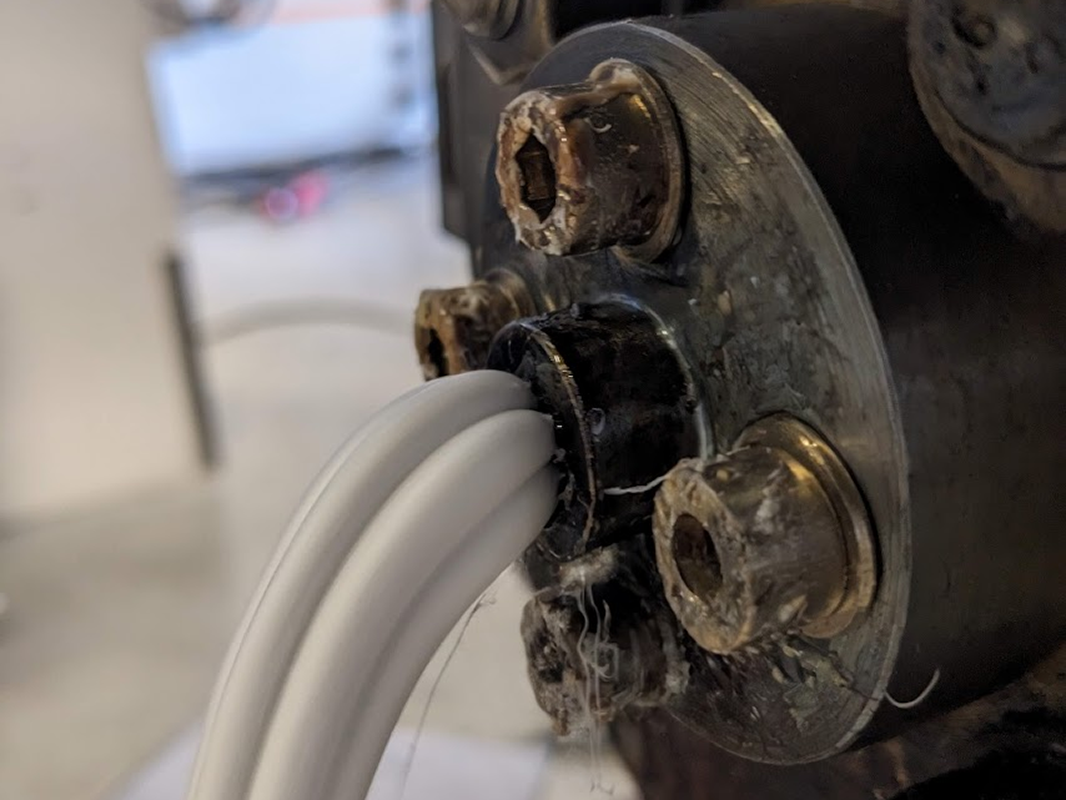
Foam extrusion for the production of particle foam beads and lightweight, foamed plastic profiles for technical applications.
Extrusion foams
Extrusion foams are crucial for the production of lightweight, insulating and energy-efficient materials. The continuous extrusion process enables the cost-efficient production of semi-finished products with a constant cross-section. During the manufacturing process, a physical or chemical blowing agent is added to the polymer in the melt under high pressure. When it leaves the shaping nozzle, there is a rapid drop in pressure, which causes the melt and the blowing agent it contains to separate. This causes the material to foam up, creating a cellular foam structure. This production method enables precise control of the foam structure and density as well as the production of sheets, profiles or films with uniform material properties.
Two tandem extrusion lines are available for our research on a laboratory and pilot plant scale. Our expertise covers the entire spectrum of polymers - from standard plastics to engineering thermoplastics and high-temperature thermoplastics. We also deal with bio-based and biodegradable polymers such as polylactic acid (PLA).
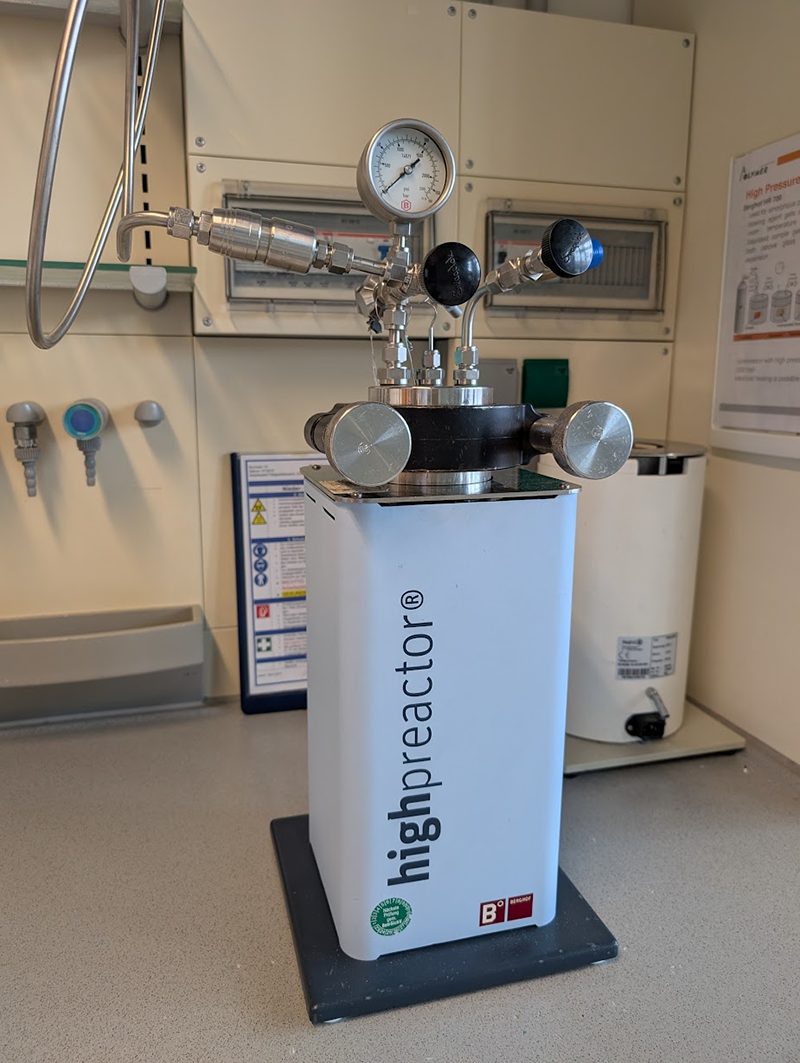
Berghhof HR-700 high-pressure autoclave for investigating the foamability of new polymer systems
Batch foams
Batch foams are polymer foams that are produced in a discontinuous process known as the batch foaming process. In contrast to continuous foam extrusion, the material is expanded in a closed autoclave under defined pressure and temperature conditions. This allows high-precision, homogeneous cell structures with special mechanical or functional properties to be produced.
Thanks to the small amount of material required and the precisely controllable process conditions, batch foaming is ideal for systematically investigating the foamability of polymers. In addition to its scientific benefits, the process also has commercial relevance and is used by various companies to produce foams.
We use batch foaming to analyze the foaming behavior of a variety of amorphous and semi-crystalline polymers. In particular, we investigate the influence of viscosity, crystallization behaviour and various process parameters on foam formation.