
1
Case StudyGePaV
Development of an automated process for the production of textile bead foam composites
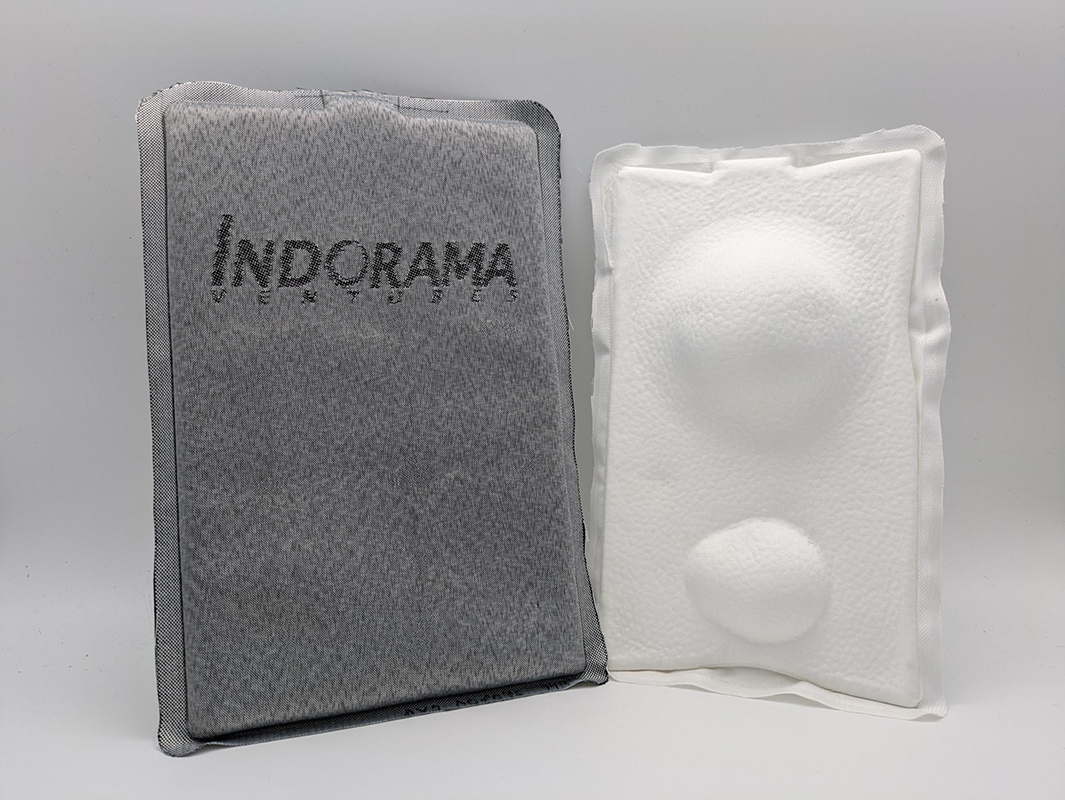
The goal of the project is the development of an automated, innovative manufacturing process for the production of textile bead foam composites with near-net-shape formation for applications in the fields of automotive, occupational safety, and sports. Multi-layer and spacer fabrics with integrated chamber structures are designed during the weaving process and directly filled with bead foam pellets. The filled fabric is then welded into a fabric-bead foam composite in a molding process. This process-integrated manufacturing eliminates subsequent finishing and lamination processes, significantly reducing weight, material usage, and manufacturing costs.

Motivation
Development of a more sustainable and cost-effective alternative to the lamination process to explore new areas of application in the automotive and sports sectors

Approach
Motivation
Replacement of the conventional lamination process
For the use in visible applications, bead foam components are often visually and functionally improved by laminating with textiles – an additional manufacturing step that is time- and cost-intensive. Therefore, the project aims to develop an automated and fully integrated manufacturing process in which textile structures and the inner bead foam core are combined into a functional composite during the weaving process. This novel process integration not only allows for a significant reduction of the finishing effort but also opens up new design possibilities through targeted shaping of the preform, haptics, and functionality of the end products. In addition to applications in the automotive sector – for lightweight, energy-absorbing, and visually appealing interior elements – integrated fabric-bead foam composites offer great potential for improving comfort and protective effects in personal protective equipment and sports articles. The material combination of both material classes creates a versatile hybrid solution that is not only functionally and aesthetically convincing but also promotes sustainable utilization and recycling strategies. The combination of these advantages results in an important building block for exploring new fields of application and substituting less sustainable material solutions.

Solution approach
Process combination
The project focuses on establishing a novel process chain that enables an innovative combination of the filling process of the bead foam pellets and the subsequent weaving process. The goal is to link the individual process steps more efficiently, thereby significantly reducing both production time and material expenditure. This integrative approach greatly minimizes the previously necessary finishing effort, which has a direct positive impact on production costs and the economic viability of the entire manufacturing process. Another decisive advantage is that subsequent lamination or back foaming of the products is eliminated, saving not only additional work steps but also reducing potential sources of error. Overall, the project contributes to making production processes future-proof and lays the foundation for more efficient and higher-quality product developments.
Approach
Fabric and process development
- Collischan GmbH & Co. KG
Development of a novel filling process and its integration into the weaving process to enable automated filling of the fabrics. - SCHRAML Metallverarbeitung GmbH & Co. KG
Tool development to ensure suitable fixation of the fabrics and a homogeneous distribution of the bead foam pellets during processing. - Institute for Materials Science of Hof University (ifm), Campus Münchberg
Development and production of various textile bindings and spacer fabrics on a laboratory scale. Integration of the filling unit into weaving machines on a laboratory scale. - Indorama Ventures Mobility Krumbach GmbH & Co. KG
Development and production of textile multi-layer fabrics through contour-appropriate weaving design on an industrial scale. Integration of the filling unit into weaving machines on an industrial scale. - NMB + ifm
Development of optimal material combinations (textiles, bead foams) for successful composite component development - Neue Materialien Bayreuth GmbH
Adjustment of the process management for processing of fabric structures filled with bead foam on steam-based molding machines and production of the components. - ALL
Production and evaluation of demonstrators.
Project sponsor: Bavarian State Ministry for Economic Affairs, Regional Development and Energy | Funding code: MW-2112-0021
Partners: Indorama Ventures Mobility Krumbach GmbH & Co. KG, SCHRAML Metallverarbeitung GmbH & Co. KG, Collischan GmbH & Co KG, Institute for Materials Science of Hof University (ifm), Campus Münchberg