

1
Case StudyGePart
Development of efficient process technologies within the closed EPP bead foam material cycle
The aim of the project is to sustainably close the material cycle of EPP bead foams by developing and establishing innovative and application-oriented recycling processes. In this way, EPP components are to be efficiently processed after their service life and reintroduced into the production process in high quality. Another central focus is the targeted further development of the novel radio frequency (RF) process technology. This is to be optimized so that a process-safe and economical processing of EPP with a significant recycled content can be reliably implemented even in industrial series production. Thus, the project makes an important contribution to resource conservation, CO2 reduction, and the establishment of a functioning circular economy in the field of technical foam plastics.

Motivation
Increasing relevance of resource and energy efficiency in the production and processing of bead foam molded parts based on EPP

Approach
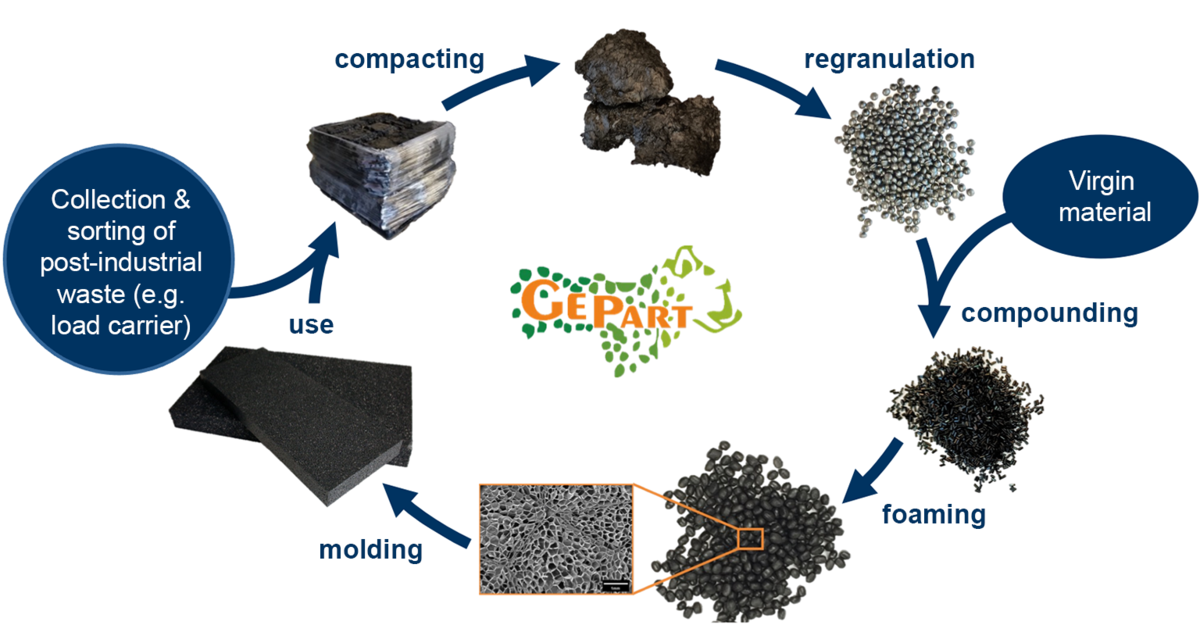
With the GePart project, the foundation for a closed material cycle of EPP bead foams is being created – a significant contribution to the establishment of sustainable material cycles, the saving of fossil resources, and the reduction of CO2 emissions in the plastics processing industry.

Motivation
Resource efficiency in the production and processing of EPP
Bead foams such as expanded polypropylene (EPP) are characterized by excellent lightweight construction and damping properties, thus offering significant potential for use in sustainable applications – particularly in the areas of mobility and packaging. Despite these advantages, a significant disadvantage currently stands in the way of broader ecological use of these materials: a closed material cycle does not yet exist. This leads to end-of-life EPP components being only limitedly recyclable and reusable, which negatively impacts the environmental balance. Furthermore, the lack of suitable recycling solutions hinders the increased use of recycled material in industrial manufacturing. This creates an urgent need for action to improve the circularity of EPP bead foams and to fully exploit their contribution to resource conservation and emission reduction.

Solution Approach
Circular material management of EPP
Through the development of specifically tailored recycling processes and the continuous optimization of efficient processing technologies – particularly the innovative RF technology – a significant increase in the use of recyclates in the production of EPP bead foams is made possible. These advances contribute significantly to conserving valuable resources by reintroducing secondary raw materials into the material cycle. At the same time, CO2 emissions along the entire value chain are noticeably reduced. Thus, the project creates important prerequisites for the implementation of a functioning and sustainable circular economy in the field of EPP bead foams and makes a relevant contribution to achieving ecological and climate policy objectives.
Approach
Development of tailored recycling technologies and efficient processing methods
- Establishment of a processing strategy for PP that enables the conversion of end-of-life EPP molded parts and old PP into EPP raw material.
- Enabling the RF technology for series-capable processing of EPP for the production of multidimensional bead foam components
- High incorporation of 50-70% recycled EPP using RF technology for sustainable closure of the material cycle
- Implementation of a holistic life cycle assessment to demonstrate the CO2 savings potential along the bead foam process and material cycle
- Increasing the understanding of the material-process-cycle-structure-property relationships through comprehensive material characterizations and numerical considerations with the aim of maximizing the reuse of EPP.
Project sponsor: Federal Ministry for Economic Affairs and Energy (BMWE) | Funding code: 03LB2000F
Partners: Ruch Novaplast, Volkswagen, Kaneka, RPlast, T. Michel, Kurtz Ersa, Institute for Lightweight Construction and Plastics Technology