

1
Case StudyKONKAV
Cost-effective and sustainable production of Urban Air Mobility cabin modules
The KONKAV project primarily aims at the development of sustainable and weight-optimized components for cabin parts in the field of Urban Air Mobility (UAM). By using innovative lightweight construction concepts, resource-saving materials, and efficient manufacturing technologies, a new standard for environmentally friendly aviation systems is to be established. The goal is to significantly improve the energy efficiency of future UAM vehicles, reduce the CO2 footprint in production and use, and at the same time meet the highest requirements for safety, comfort, and functionality. In this way, KONKAV makes an important contribution to the sustainable transformation of the aviation industry and the design of climate-friendly mobility solutions in urban areas.

Motivation
Cost-effective and sustainable production of Urban Air Mobility (UAM) cabin modules to reduce the ecological footprint

Approach
With the KONKAV project, we are setting new standards in sustainable lightweight construction for urban air mobility – through the targeted use of recyclable bead foam monomaterial solutions and an innovative in-situ direct foaming process, we are laying the foundation for energy-efficient, circular cabin components of the next generation.

Motivation
Sustainable form of mobility
Urban Air Mobility (UAM) as a future mobility concept offers the potential to make urban passenger transport more efficient, flexible, and independent of conventional road traffic. To accompany this development while also taking ecological responsibility into account, it is essential to consider the environmental impacts of this new form of mobility already in the early development phase. In particular, the design of the cabin modules plays a central role: resource-saving material selection, consistent lightweight construction approaches, and a recycling-friendly, modular construction method are crucial factors in reducing the overall weight of the aircraft, increasing energy efficiency, and sustainably lowering CO2 emissions during operation. Furthermore, modular structures enable better maintainability, an extended lifespan of the components, and a more flexible adaptation to different usage scenarios. The targeted development of such sustainable cabin modules is thus an essential building block for the successful and environmentally compatible implementation of Urban Air Mobility in urban areas.

Solution Approach
Development of weight-optimized bead foam hybrid components for weight reduction
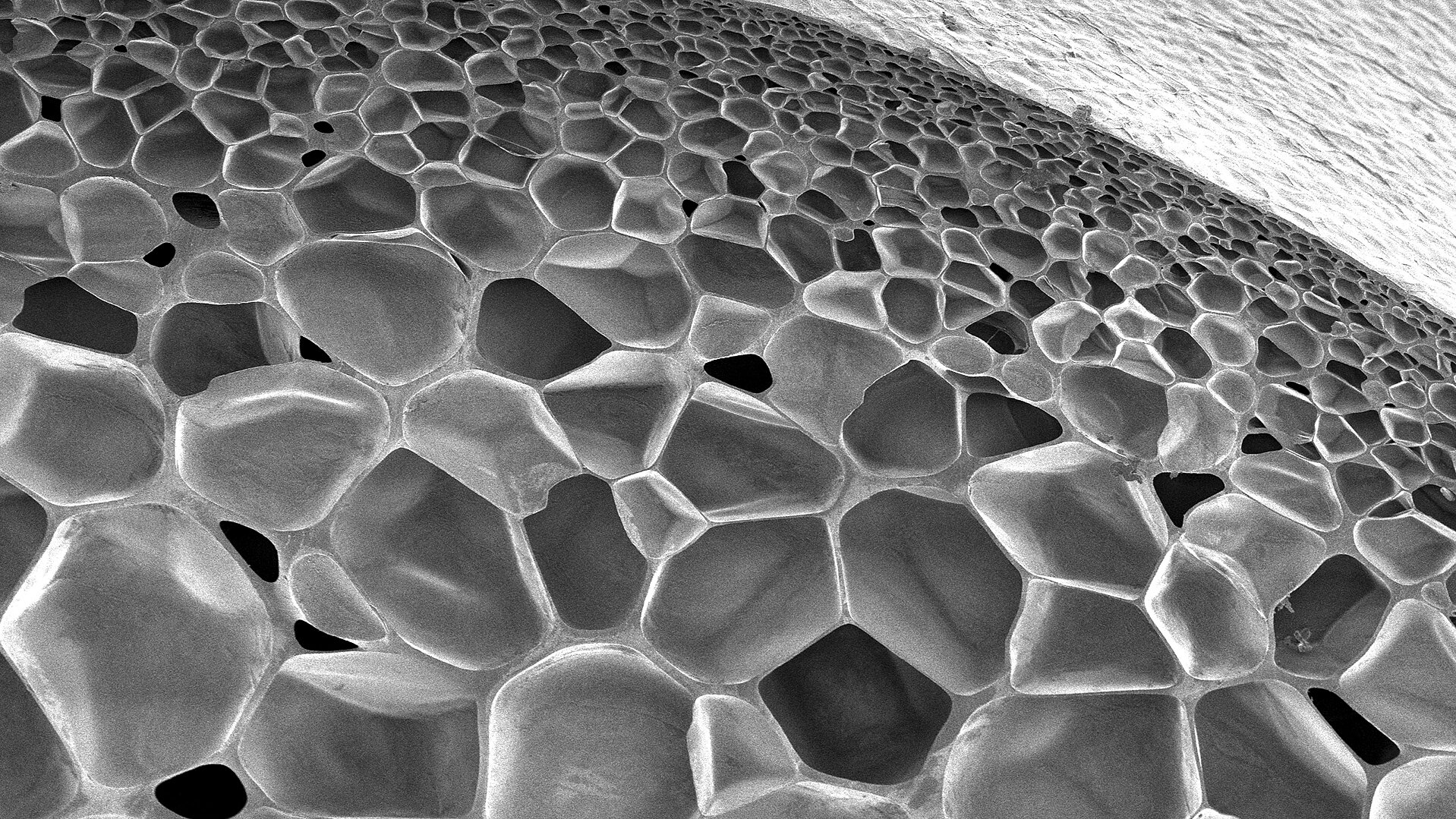
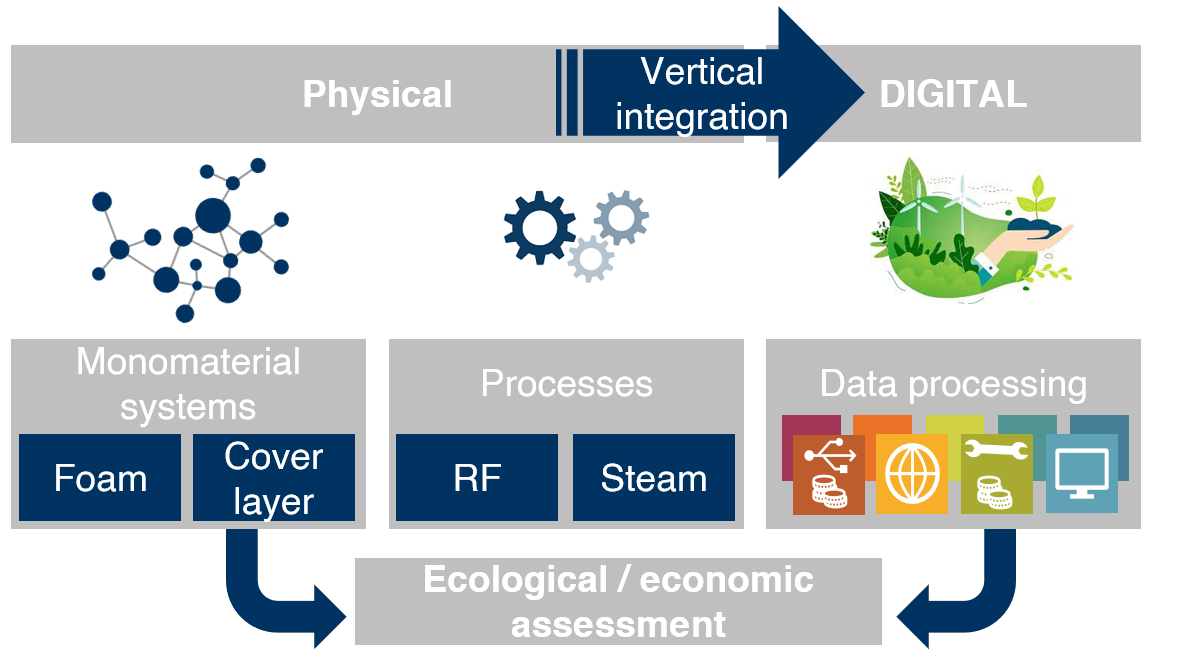
To consistently minimize the component weight, the project pursues a highly integrated hybrid lightweight construction approach with bead foams, which allows for a reduction of the area weight by about 50%. Suitable monomaterial systems are first identified that can be integrated as both a bead foam core and in the outer surface-layers to implement mono-polymer- and thus recycling-friendly sandwich structures. In parallel, the development of an in-situ direct foaming process, where thermoplastic films are directly welded to the bead foam as an outer layer is a focus topic. This is done using steam-based and steam-free (RF technology) processing methods. In addition to significant weight and energy savings, this process leads to improved component quality and shorter cycle times – crucial prerequisites for sustainable, economical, and circular production of UAM cabin components.
Approach
Development of an in-situ direct foaming process for bead foams
- Conceptualization and production of bead foam hybrid components for a UAM application
- Definition of application-related evaluation criteria for the materials and the components produced from them
- Screening of potential bead foam and outer layer materials
- Process development for in-situ direct foaming of complex components
- Ecological assessment of the NMB processing technologies and the materials used, as well as assessment of economic viability
- Development of end-of-life recycling concepts
Project sponsor: Federal Ministry for Economic Affairs and Energy (BMWE) | Funding code: 20K2105D
Partners: Diehl Aerospace GmbH, Diehl Aviation Laupheim GmbH, University of Bayreuth Chair of Polymer Materials, University of Stuttgart Institute of Aircraft Construction, Institute of Textile Technology Augsburg gGmbH, RWTH Aachen - Institute of Structural Mechanics and Lightweight Construction, Airbus Urban Mobility GmbH