
Additively manufactured RF tools for energy-efficient bead foam processing: Project start 3D RadioTool
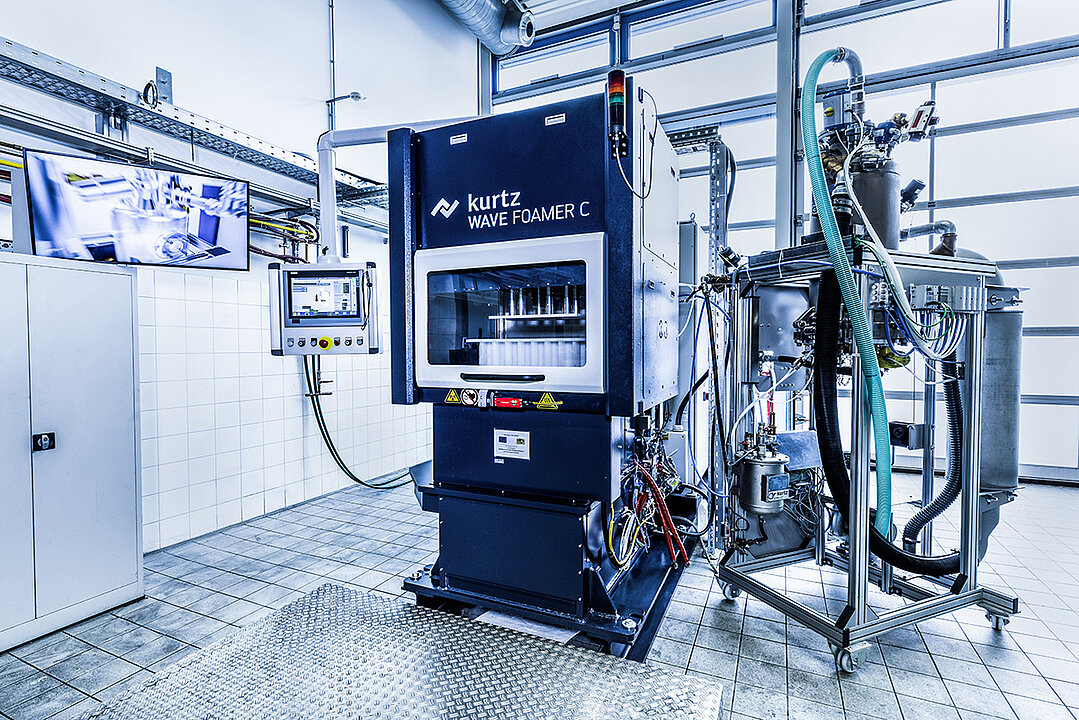
Kurtz Wave Foamer C for testing additively manufactured RF tools in the 3D RadioTool project.
Bead foams such as EPS, EPP, and E-TPU already make an important contribution to weight reduction in vehicles, packaging, and sports applications. However, the production of the components mainly takes place using hot steam, with a large part of the energy used being lost. The research project 3D RadioTool therefore aims to develop additively manufactured tools for the radio frequency process (RF) that can passively heat up directly in the radio frequency field, thus enabling efficient welding of the foam beads without external tool temperature control.
The combination of novel tool materials and additive manufacturing represents a completely new approach to bead foam processing. By utilizing a granulate-based 3D printing process, tools with high geometric freedom can be produced. At the same time, special functional layers can be integrated that allow targeted heating of the tool surfaces through the RF field. This can reduce energy losses, shorten cycle times, and improve process stability.
Neue Materialien Bayreuth GmbH focuses on the development of a novel tool material with defined dielectric properties, high temperature resistance, and excellent electrical stability in the project. By specifically modifying high-performance thermoplastics and using functional fillers, materials are to be created that can passively heat to temperatures above 175 °C and are simultaneously suitable for use in granulate-based 3D printing.
Malping GmbH is simultaneously developing a special manufacturing process based on Fused Granulate Fabrication (FGF) to process the newly developed materials into complex RF tools. Simulation-supported tool development and optimized printing strategies are intended to ensure homogeneous heating and a long service life of the tools.
“With 3D RadioTool, we are laying the foundation for a new generation of energy-efficient tool technologies in bead foam processing. The combination of innovative material concepts, additive manufacturing, and radio frequency technology opens up completely new possibilities for sustainable and economical production of lightweight components”, explains Dr. Andreas Köppel, head of the foam competence field at Neue Materialien Bayreuth GmbH.
The project addresses both ecological and economic challenges in the industry. The goal is to reduce energy consumption compared to conventional steam technology. At the same time, the technology opens up new possibilities for processing technical bead foams based on PET, PBT, or PA, which can only be processed to a limited extent with classical steam methods.
At the end of the project, a functional demonstrator is to be created, with which the energy-efficient production of bead foam components under practical conditions will be demonstrated. In this way, 3D RadioTool makes an important contribution to the sustainable transformation of the plastics industry and simultaneously strengthens the competitiveness of the industrial location Germany in the field of modern lightweight and manufacturing technologies.
The research project “3D RadioTool” is funded as part of the Central Innovation Program for SMEs (ZIM) of the Federal Ministry for Economic Affairs and Energy (Funding code: KK6074304CM5).
Contact Person