
Digital technologies for high-quality EPP bead foams from complex recycled material streams: ReMEPP project launch
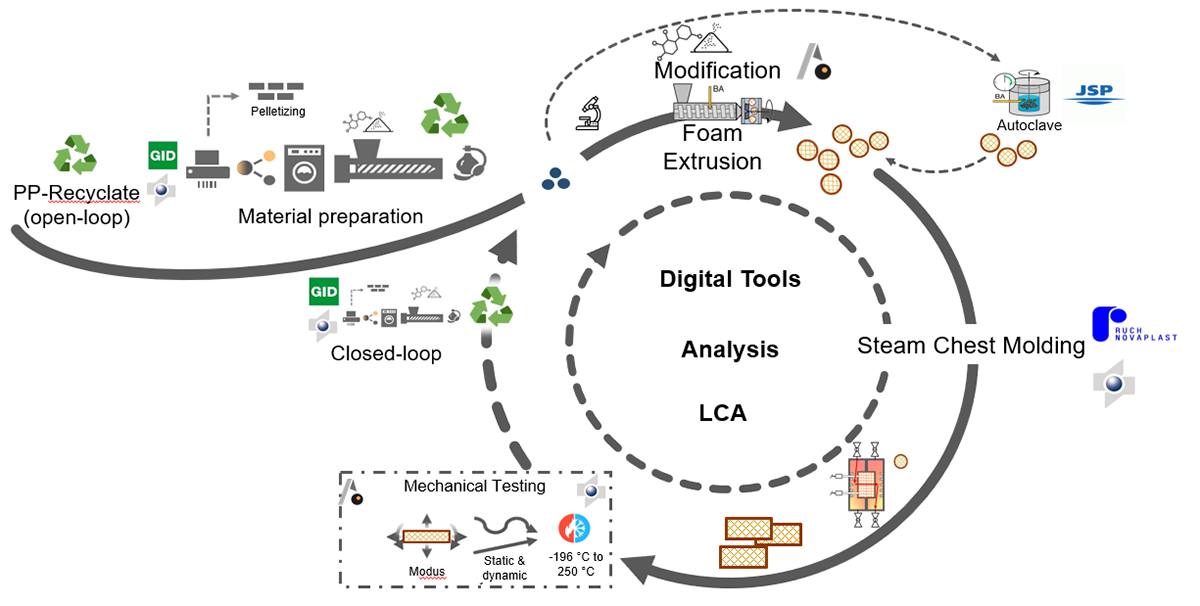
Graphical abstract of the ReMEPP project: From variable PP recyclate streams to high-quality rEPP moulded parts using data-driven methods.
Expanded polypropylene (EPP) is a versatile lightweight material whose low density and favourable mechanical properties support resource-efficient and sustainable product solutions across a wide range of applications. Against the backdrop of the European Green Deal’s circular economy objectives and regulatory developments in the packaging and automotive sectors, EPP recycling is becoming increasingly important. Demand for high-quality rEPP is therefore growing, particularly in these industries. To date, however, production has largely relied on high-purity, well-sorted PP recyclate streams, whose limited availability makes it difficult to meet growing demand in the long term.
ReMEPP addresses this challenge by exploring the use of more heterogeneous and complex recycled PP feedstocks alongside the well-sorted material streams already established in EPP production. A key obstacle is the variability in feedstock composition and contamination levels, which conventional process control can only compensate for to a limited extent. These variations can adversely affect both processing behaviour and the properties of the foam beads and finished moulded parts, restricting their suitability for demanding applications. Achieving consistent product quality therefore requires processing conditions to be carefully tailored to material properties.
One of the project’s main objectives is to develop an intelligent, data-driven predictive model that learns from collected data to assess recycled feedstock quality in real time and support targeted process optimisation. Material and process data will be collected and linked across the entire production chain, from recyclate preparation and foam bead production to the manufacture of moulded parts. Machine learning will be used to identify relationships between feedstock properties, processing conditions and final product quality, providing the basis for process and quality predictions. Suitable inline analysis methods will detect relevant material variations during processing, enabling proactive adjustments to processing conditions.
Within the project, NMB combines application-oriented material and process development with a comprehensive assessment of environmental impacts. A key focus is the preparation of heterogeneous recycled PP feedstocks to obtain high-quality input materials for foam bead production. NMB also investigates the processing of the resulting rEPP beads into moulded parts. An accompanying life cycle assessment will quantify the environmental impacts of the solutions developed and identify opportunities to reduce their carbon footprint. This allows material and process combinations to be assessed during development for both technical performance and environmental benefits.
The project consortium brings together four partners from industry and research whose complementary expertise covers the entire process chain, from recycling to finished moulded parts. Alongside NMB, the partners are General Industries Deutschland GmbH (GID), an experienced recycler of EPP load carriers; the Department of Polymer Engineering at the University of Bayreuth, which contributes expertise in bead foam production and data-driven process optimisation; and RUCH NOVAPLAST GmbH, a specialist in the industrial production of bead foam moulded parts, including products for heating, ventilation and air conditioning applications. JSP supports the consortium as an associated partner.
By bringing together plastics recycling, material development and digital technologies, ReMEPP aims to lay the groundwork for the wider use of recycled PP feedstocks whose suitability for EPP production has so far been limited. The project thus offers opportunities to conserve virgin raw materials, keep plastic waste in circulation through high-quality recycling and improve resource efficiency in the production of EPP moulded parts.
The ReMEPP research project is funded by the German Federal Ministry of Research, Technology and Space (BMFTR) as part of its GreenTech Innovation Competition (grant number: 01MN26004B).
Contact Person