
Polyurethane In-Mold Coating of Sensitive Surfaces as a New Manufacturing Route for Functionally Integrated Components: NMB Launches PURTECT Research Project
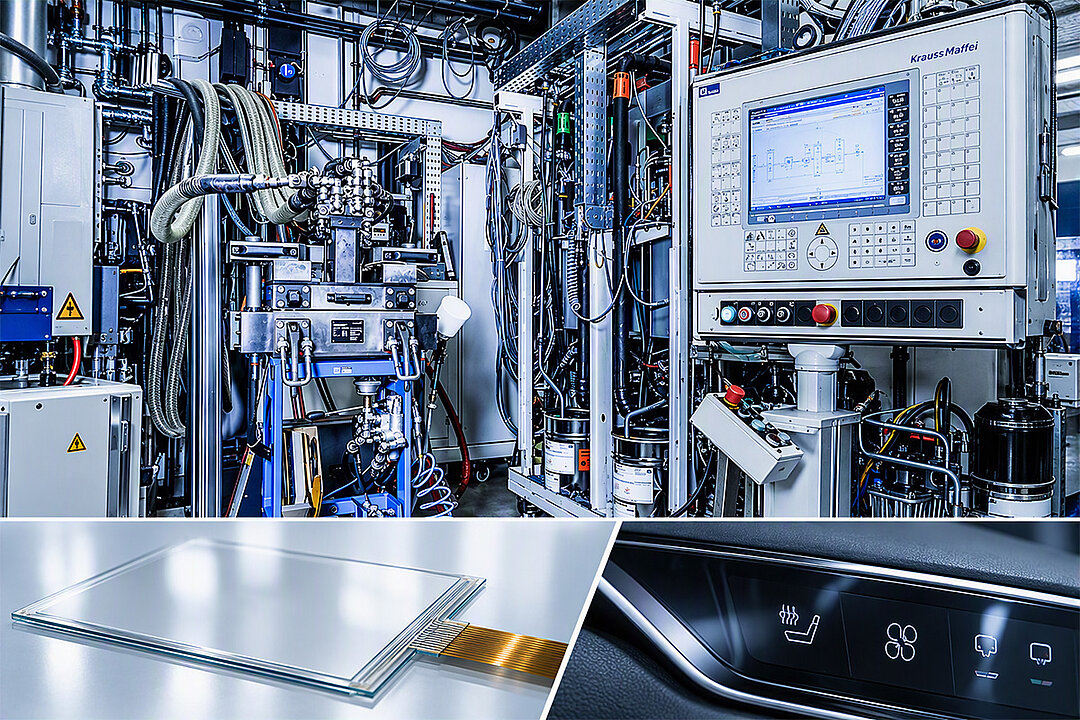
Polyurethane In-Mold Coating incl. applications
Control panels in cars, machine controls and monitors in medical technology have sensitive surfaces with important functions. In addition to scratch resistance and resistance to chemicals and UV radiation, a fracture behavior that produces as few splinters as possible is required. However, direct coating places high demands on the manufacturing process. Heat and pressure can damage fine structures, while the protective layer must remain optically clear. Touch displays are therefore usually protected by a separate cover glass, which is bonded to the sensor and display in several cleanroom steps using optically clear adhesives, making the process complex and prone to errors.
Against this background, the PURTECT research project aims to produce the protective layer directly on the sensitive surface inside the closed mold. The basis is Polyurethane In-Mold Coating (PUR-IMC), which is already used to coat plastic components in large quantities in the automotive industry. A liquid, reactive polyurethane fills the gap between the component and the mold within a few seconds and cures there to form a durable protective layer. The process operates at comparatively low temperatures and pressures and therefore generally offers potential for sensitive components.
In the project, Neue Materialien Bayreuth is investigating the interactions between material, process control, interface and component function. The key question is the conditions under which an adhesion-resistant, homogeneous and optically clear PUR layer forms on the functional surface. To achieve this, the processing temperature, mold cavity pressure and heat of reaction must be coordinated so that the sensitive substrates are not damaged while a durable protective layer is still produced. Sensors integrated into the coating mold record pressure, temperature and the curing profile in real time. Data-based optimization supports the efficient determination of suitable process parameters.
At the end of the project, a coated demonstrator is intended to show whether sensitive sensor surfaces can be protected using PUR-IMC without losing their function. PURTECT thus provides a foundation for further research and subsequent transfer to industry. Beyond coating, the approach opens up prospects for additional surface functions. Micro- and nanostructures could be transferred directly into the PUR layer during molding, for example to provide anti-fingerprint properties. If successful, this would make it possible to combine surface design and functionalization in a single manufacturing step and reduce the need for additional layers or subsequent processing.
The “PURTECT” research project is funded under the funding guideline “Investigation of High-Risk Ideas in the Field of Materials and Materials Research (Experiment!Material)” by the Federal Ministry for Research, Technology and Space (BMFTR) (funding reference number: 13XPM532).
Contact Person