

1
Case StudyVOFree-HM
New Process Route for Procurement-Critical Hard Metals
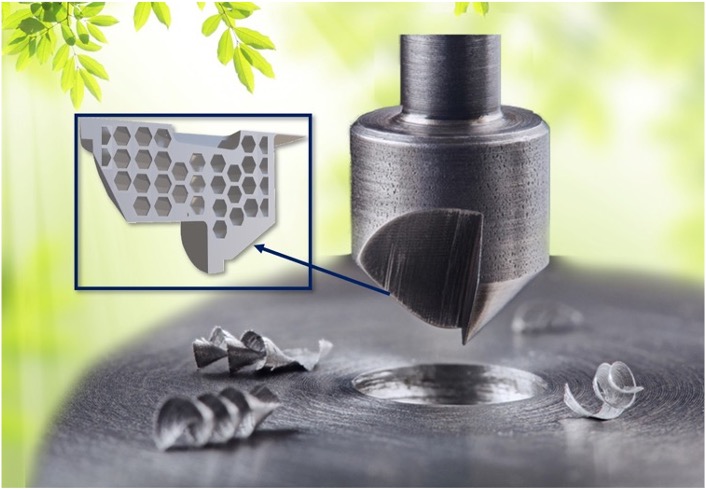
The increasing demand for milling tools in e-mobility meets cost-intensive manufacturing processes: Currently, they are mostly made from procurement-critical tungsten carbide in cobalt matrix – with high material loss. NMB is therefore developing an alternative manufacturing route based on the Fused-Filament-Fabrication (FFF) process. This allows milling head blanks to be produced close to final contour, resource-efficiently, and with up to 45% material savings – with minimal waste.

Approach

Motivation
Cost-Intensive Powder Metallurgy
The growing e-mobility is also changing the production landscape. One example of this is drive shafts: Conventional drives have a maximum of eleven of them, while the number is higher for electric drives. Accordingly, the demand for milling tools used to manufacture these components is increasing. Currently, these precision milling cutters are produced using cost-intensive powder metallurgy with high material consumption. Tungsten carbides in cobalt matrix are most commonly processed. Both tungsten and cobalt are considered procurement-critical raw materials in Germany.

Solution Approach
Fused-Filament-Fabrication (FFF) Process as an Alternative Manufacturing Method
As a procedural alternative, additive manufacturing for close-to-final contour production of components is suitable, where material usage can be significantly reduced. However, the 3D printing of tungsten carbide is technically severely limited due to its extreme hardness. Therefore, NMB has developed a new manufacturing route for milling head blanks made of hard metal – based on the Fused-Filament-Fabrication (FFF), a sinter-based 3D printing process. By eliminating the grinding sludge generated in conventional processes and the low material consumption in the process, material savings of up to 45% are achieved – with simultaneously minimal waste.
Approach
Longer Lifespan of Printed Hard Metal Tools with Reduced Material Usage
- Further development of the Fused-Filament-Fabrication (FFF) process for processing complex components with high dimensional accuracy
The further development of the Fused-Filament-Fabrication (FFF) process aims to significantly enhance the manufacturing of complex and high-quality components through improved printing parameters, optimized nozzle geometries, and novel filament materials. This not only allows for higher dimensional accuracy and better mechanical properties but also enables the efficient and reproducible production of function-integrated structures. - Optimization of the manufacturing process for hard metals, particularly regarding porosity and material properties
The optimization of the manufacturing process for hard metals focuses on minimizing porosity to achieve high material density and improved mechanical properties. By precisely controlling the sintering parameters, temperature profiles, and subsequent post-processing steps, the microstructure is deliberately solidified. This significantly increases the hardness, wear resistance, and lifespan of the components. - Establishment of a continuous process chain from additive manufacturing to the final sintering process
For the efficient production of high-quality hard metal components, a continuous process chain is established from the additive manufacturing process to the final sintering process. By optimizing process transitions and a new component design, for example, material usage is reduced and the mechanical properties of the products are improved. - Conducting a Life Cycle Assessment (LCA) to evaluate the ecological and energetic efficiency of the overall process
The analysis of the ecological impacts along the entire manufacturing process includes the systematic assessment of energy and raw material consumption as well as waste streams at each process stage – from the use of the raw material to the manufacturing of hard metal tools to post-processing. The goal is to identify ecological hotspots and sustainably improve the environmental balance through targeted measures, such as process optimizations or material substitutions.
Project sponsor: Federal Ministry for Economic Affairs and Energy (BMWE), Central Innovation Program for SMEs (ZIM), Central Innovation Program for SMEs (ZIM) | Funding code: KK5027509KL2
Partners: Peter Würtele; Klaus Trott