

1
Case StudyRobustSkin
Material and process solutions for a novel wing construction method based on bionic principles
Weight reduction is the central approach for eco-efficient flying. Therefore, the project goal was to create an innovative lightweight construction concept as a prerequisite for more sustainable air traffic. The bionic principle of a dragonfly wing was used as a model and inspiration from nature. The transfer of this principle from nature to aerospace is particularly important for the development of new aircraft, such as slow-flying aircraft like the Zephyr, or in Urban Air Mobility.

Motivation
The goal of the project was an eco-efficient realignment of air transport, with weight reduction playing a central role.

Approach
Research and development are key to making significant progress towards eco-efficient flying. This will help ensure that the transportation sector is positioned for sustainability in the future.

Motivation
Efficient lightweight construction for wings through bionic concepts
The goal of the project was to expand the application and increase the efficiency of fiber-reinforced plastics in aviation with the aim of minimizing consumption. Currently used fiber composite laminates for commercial aircraft wings are overengineered due to impact events (e.g., hail) and the associated damage tolerance requirements, which prevents thin-walled and lighter constructions. Instead, basic investigations (up to TRL 3) should be done to consider an alternative lightweight construction inspired by nature (dragonfly wings). Suitable simulations should be excecuted to illuminate the minimal necessary material use.

Solution Approach
Through material and impact tests to the wing in technical scale
In the first phase, the material properties were validated through tensile tests. Stiffness, strength, and elongation until fracture were recorded. Additionally, the cyclic behavior was analyzed. In the second phase, the unreinforced membrane materials were characterized through impact tests to define the intrinsic material behavior at different impact energies and different biaxial prestress. In the third phase, impact tests were conducted with the fiber-reinforced membrane. In the final phase, a full-size wing was created to determine the effects of the individual parameters.
Approach
Hierarchically reinforced, prestressed membrane structural construction
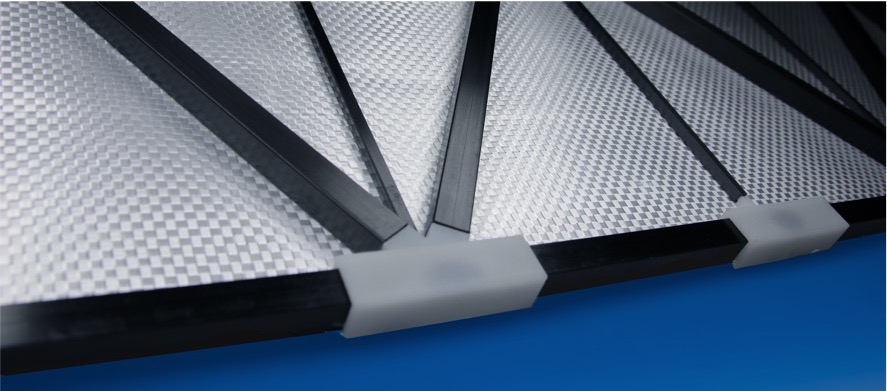
The project result is a novel structural construction approach based on a hierarchically reinforced, prestressed membrane solution. This consists of a stiffening structure made of load-optimized carbon fiber reinforced profiles (grid structure), which is applied to a prestressed membrane (skin structure).
- Appropriate material selection: The evaluations were based on tensile tests and mechanical impact tests in the prestressed biaxial state.
- Own test stand: By developing an own test stand, special loads, such as hail impact, could be simulated.
- Numerical modeling and simulation: The real results were compared with the simulation to generate the best possible predictions.
Project sponsor: Bavarian Research Foundation | Funding code: AZ-1524-21
Partners: Technical University of Munich; Airbus Defence and Space GmbH