

1
Case StudyMonoMat
Cascaded Monomaterial Use for Resource-Efficient Manufacturing
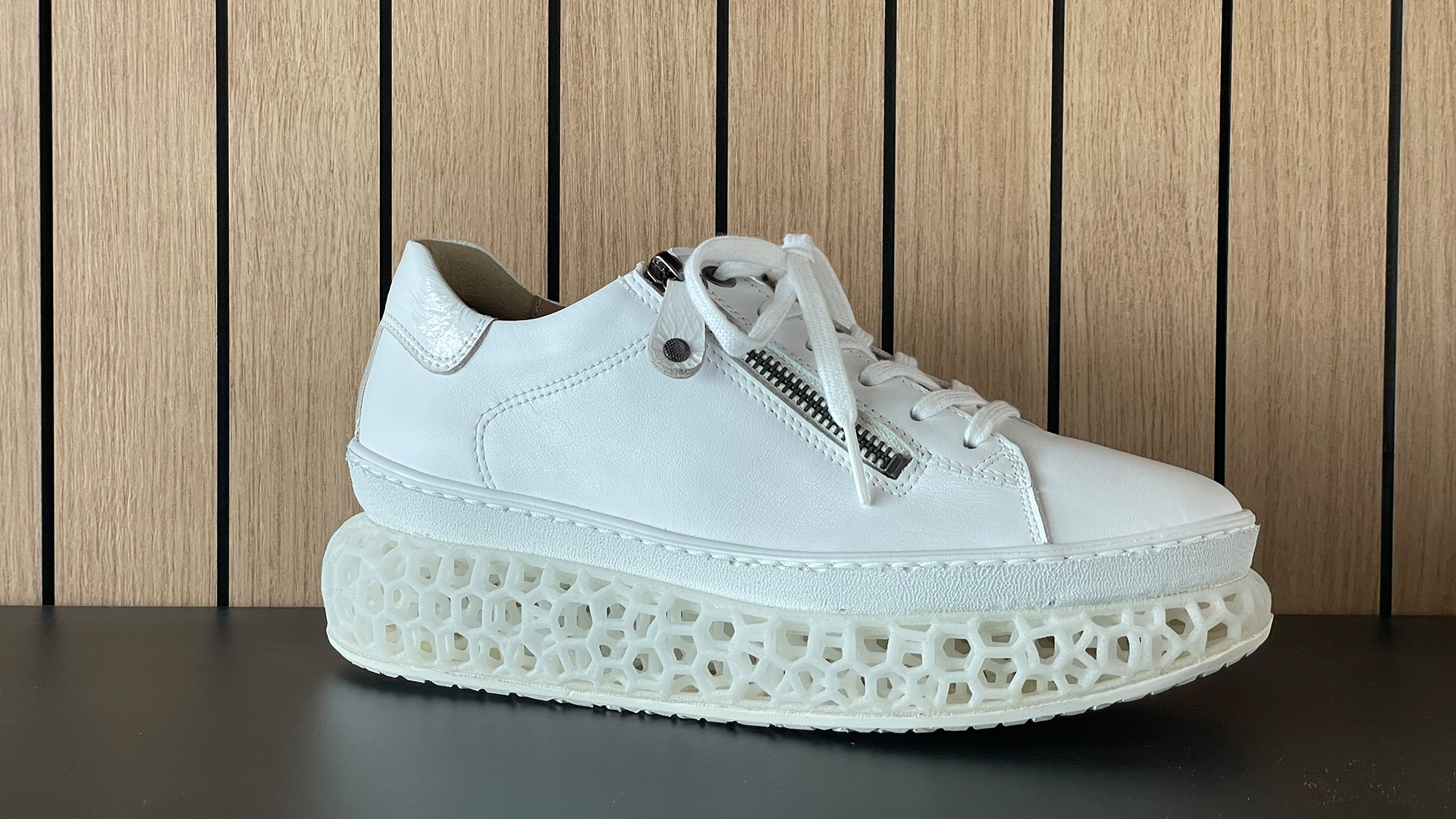
The project aims to develop individually customizable monomaterial components for sustainable consumer goods. Through a cascaded manufacturing concept – from powder-based 3D printing to extrusion to injection molding – the material is reused multiple times. Structures are designed based on simulations, optimized for specific applications (e.g., shoe sole, backpack pad), and biomechanically tested. A life cycle analysis ensures the ecological assessment.

Approach
One material, many lives – MonoMat opens new paths for functional, recyclable components with minimal resource use.


Motivation
Monomaterial Strategy for Sustainable Production of Individual Consumer Goods
Sustainable and individually customizable consumer goods require new, holistic development approaches. The monomaterial approach enables a pure return of materials and creates the foundation for a true circular economy – without complex separation or recycling processes. At the same time, the functional requirements for the products are increasing, such as regarding cushioning, flexibility, or structural load-bearing capacity.
To meet these requirements, a focus is placed on structurally optimized designs instead of multimaterial systems. The mechanical properties are generated through additive manufacturing processes and topologically adapted geometries.
This strategy enables the functional design of components while simultaneously minimizing the ecological footprint. Digital development, automated process control, and systematic life cycle analysis form the basis for an economically and ecologically viable implementation.

Solution Approach
Connected, Automated, and Digital Development Along the Entire Material and Process Chain
The project aims to develop individualized monomaterial components that meet specific functional requirements – exemplarily demonstrated with shoe soles featuring targeted cushioning and backpack pads with optimized pressure distribution and ventilation. The mechanical properties are adjusted solely through the geometry of additively manufactured structures. This allows for flexible adaptation to the application case without the use of different materials.
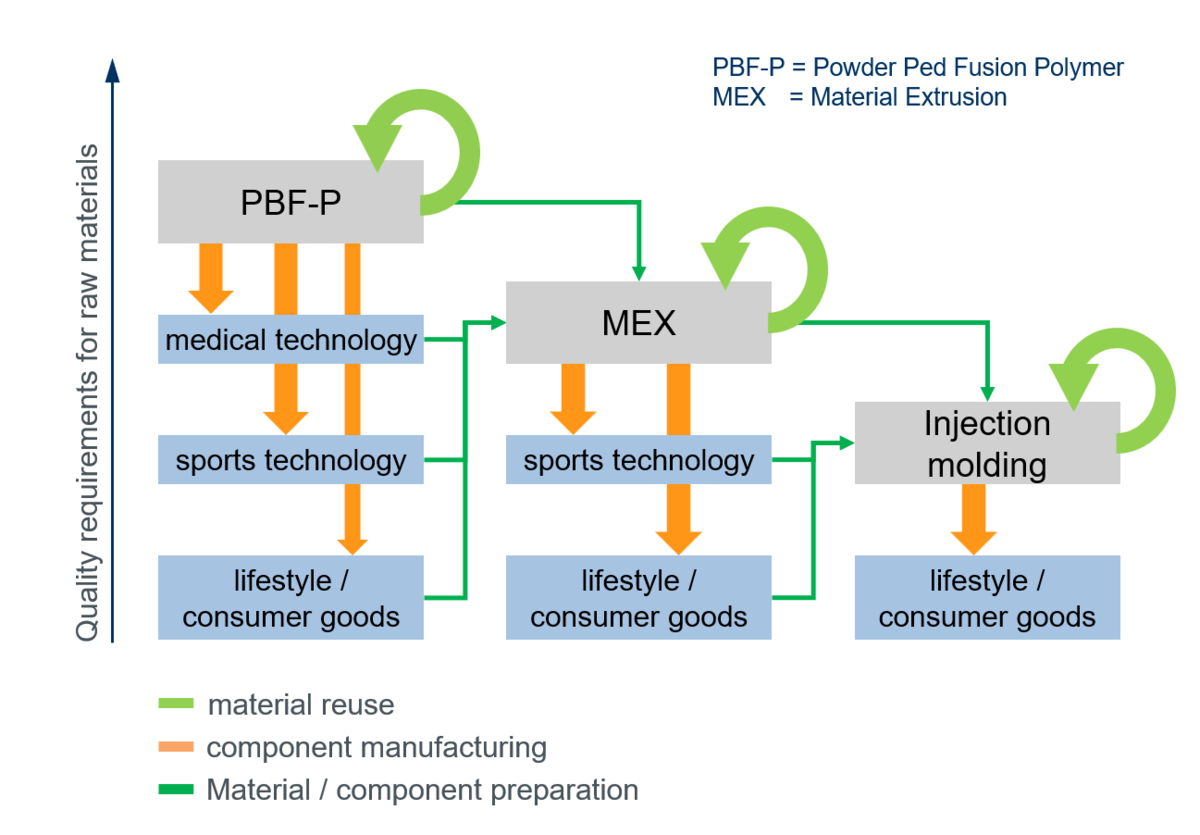
The manufacturing follows a cascaded process concept: The material is initially used in powder-based additive manufacturing, then reused in extrusion, and finally utilized in injection molding. The goal is to maximize the use of material resources across multiple usage stages before they are sent for recycling. Analytical methods (e.g., DSC, CamSizer, etc.) ensure material performance across different refresh cycles, guarantee processability, and enable the identification of relevant correlations. The structural design is simulation-based and specifically tailored to biomechanical requirements. Functionality is validated through application-specific biomechanical tests with subjects. Additionally, a life cycle assessment is conducted across all process stages to comprehensively capture the environmental impact of the overall system and to identify optimization potentials early on.
Approach
Resource-Saving Design and Validation of Functional Components
- Development of monomaterial-based structural components
Design and additive manufacturing of functional structures with locally adjustable mechanical properties (e.g., cushioning, stiffness) - Validation of material reusability
Use of recycled TPU and PBT over multiple process cycles; continuous analysis of powder, granulate, and components - Structural simulation and application-specific adjustment
Simulative optimization of lattice structures to meet defined requirements (e.g., midsole, backpack pad) - Biomechanical validation
Proof of component functionality through tests on subjects in real application contexts - Life cycle and recycling-related assessment
Life cycle analysis of the process chain as well as assessment of ecological impacts and recyclability
Project sponsor: Federal Ministry for Economic Affairs and Energy (BMWE) | Funding code: 03LB3054B
Partners: University of Bayreuth (Chair of Construction and CAD, Chair of Environmentally Friendly Production Technology), Hans WEBER Maschinenfabrik GmbH, OECHSLER AG, AM Polymers GmbH