

1
Case StudyAl-G
Al-Fe Materials for Coating Glass Molds
In the glass industry, extreme thermal and abrasive stresses require highly durable mold coatings. However, nickel-based coatings are increasingly considered critical – due to supply shortages and health risks. NMB relies on a sustainable alternative: in-situ formed Al-Fe coatings, applied using modern thermal spraying processes. Initial tests show comparable or improved wear resistance compared to conventional nickel coatings.

Motivation
High Supply Risk of Materials
In the glass industry, there are various challenges – in particular, the molds must be resistant to the very hot and abrasive molten glass. The coating is usually nickel-based and combined with other substances. However, nickel coatings are classified as critical – on one hand due to the high supply risk, and on the other hand because of the associated health risks.

Solution Approach
Al-Fe Materials
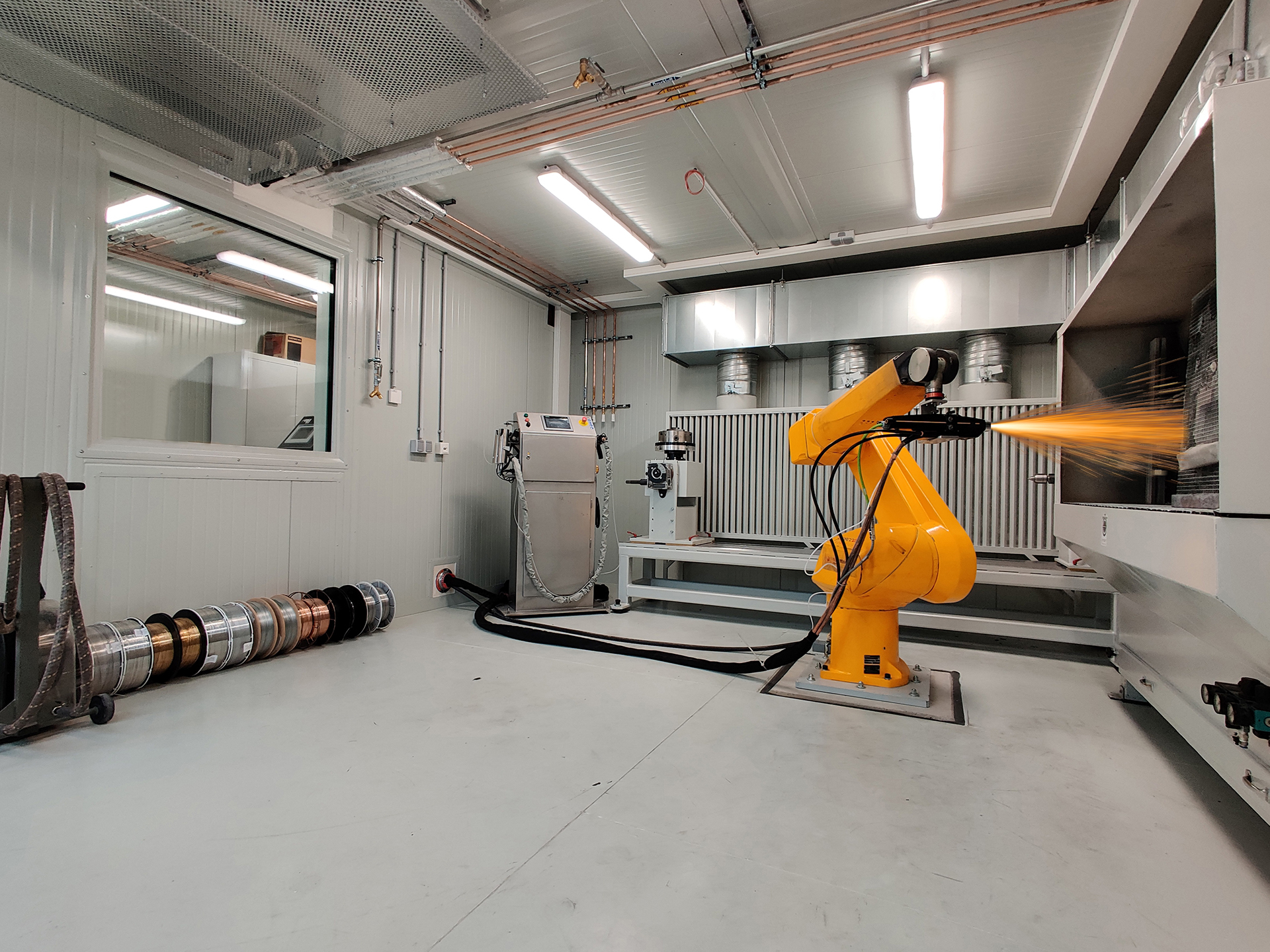
NMB has pursued an innovative solution, initially developing a sustainable, alternative coating material – with the goal of ensuring high wear resistance at the same time. Using modern thermal spraying processes from NMB, the in-situ formation of Al-Fe coatings was realized and successfully applied to complex component geometries. The wear resistance of these novel coatings was subsequently evaluated and compared with conventional coatings.

Approach
In-situ Alloying Meets Optimized Coating Processes: Rethinking Material Development and Coating Quality
- Development of targeted materials during the coating process
The in-situ alloying allows for precise adjustment of material properties to specific requirements such as thermal stability or mechanical load capacity. By selectively choosing and combining materials and process parameters during the ongoing process, the functionality of the coating can be optimized and tailored to the respective application. - Improvement of coating homogeneity through optimization of robotic processes
The homogeneity of the coating can be improved by selectively optimizing robotic coating processes. Parameters such as application speed, nozzle guidance, and coating distance are precisely controlled. By using automated systems, reproducible and uniform layers can be realized. This minimizes defects and significantly enhances the quality and functionality of the coating. - Further development of plasma and arc thermal spraying
The further development of thermal spraying with plasma and arc processes aims to increase process stability, energy efficiency, and coating properties through improved plant technology, optimized process parameters, and the use of innovative material systems. By more precisely controlling the heat source and particle velocity, targeted microstructures, higher adhesion strengths, and tailored functional layers can be produced. These meet the growing demands of modern applications.
Project sponsor: Bavarian Research Foundation | Funding code: AZ-1477-20
Partners: Rauschert Heinersdorf-Pressig GmbH, University of Bayreuth Metallic Materials, Wiegand-Glashüttenwerke GmbH