
Plasma technology meets injection molding: New process chain for stable PUR adhesion on PP
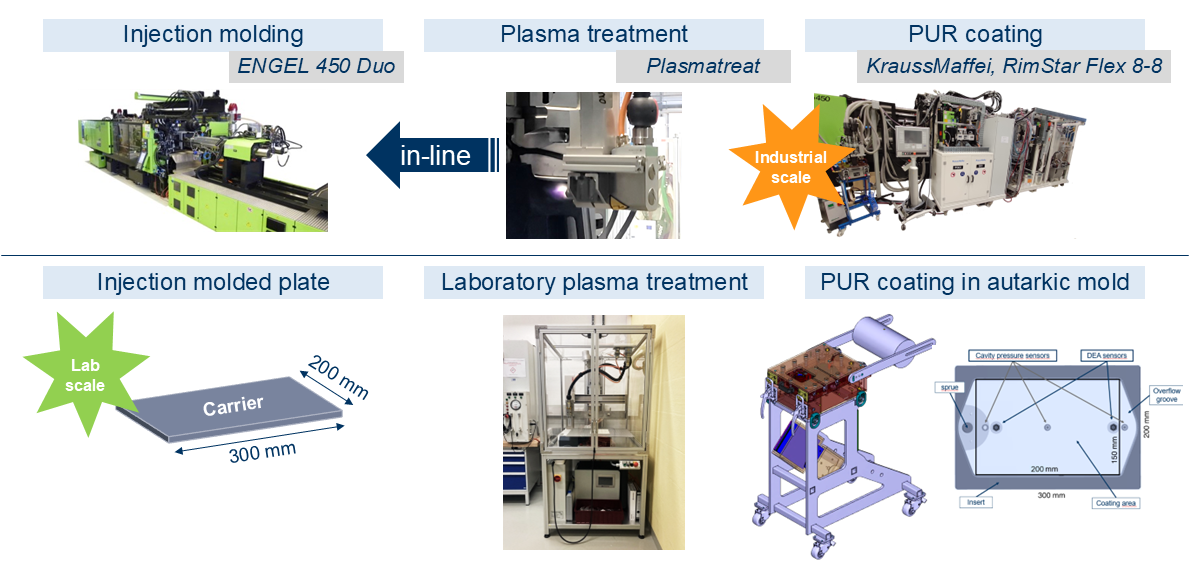
Available process routes in the technical center of Neue Materialien Bayreuth: Industrial scale (top) and laboratory scale (bottom) © Neue Materialien Bayreuth
High-quality plastic components for the automotive exterior require reliable protection against stone impact, UV influence, and mechanical stress – at the same time, the demands for sustainability and cost efficiency are increasing.
As a material for these injection molding components, polypropylene (PP) is particularly attractive due to cost and CO2 advantages, but it poses challenges for paint adhesion. Polyurethane (PUR) coating systems that meet the highest quality standards cannot be applied without suitable pre-treatment, as PUR does not reliably adhere to PP.
This is exactly where the joint concept of NMB and Plasmatreat for PUR in-mold coating comes into play. It aims to activate the component immediately after injection molding with plasma and then coat it inline with the PUR system. To modify the injection molding surface for optimal adhesion properties, the plasma pre-treatment is carried out under atmospheric pressure using compressed air and electricity. Previously separate steps – pre-treatment and coating – can thus be combined in an efficient, material-friendly process.
The focus of the research facility was on process development – from the application-oriented processing environment to data-based evaluation. For this purpose, the complete processing technology was available in the NMB technical center, including an atmospheric pressure plasma technology laboratory cell (Openair-Plasma® system from Plasmatreat) with linear handling and autonomous PUR panel tool, as well as an industry-scale turning plate injection molding machine with PUR system. This infrastructure allows experiments to be quickly transferred from the laboratory to realistic process conditions.
In activation tests, central parameters of plasma technology, such as nozzle distance and travel speed, were systematically varied. Subsequently, the adhesion strength was quantified through pull-off tests. Additionally, surface changes were evaluated through contact angle measurements and further characterizations to make activation and adhesion mechanisms comprehensible.
As a result, a first optimum of the investigated parameters could be determined. A significantly improved PUR adhesion on PP was observed, also visible in the fracture pattern. While untreated samples show no viable adhesion, plasma-activated samples exhibit ductile fracture behavior with cohesive failure in the PP layer – a strong indicator of effective interfacial activation.
Plasmatreat focused on adapting its atmospheric pressure plasma technology for the pre-treatment of large visible components. For this purpose, a novel nozzle with a treatment width of up to 450 mm was developed, which can quickly and fully activate a large surface area. It is also suitable for robot-assisted processes in high cycle times. A Plasma Control Unit ensures industrial reproducibility by controlling relevant parameters and thus supporting process safety.
The results of the cooperation between the non-university research facility and the world market leader in atmospheric plasma technology show that inline pre-treatment with atmospheric pressure plasma technology enables PUR in-mold coating on polypropylene in an industry-related manner. This provides the industry with an approach that makes cost-effective materials like PP (and its recyclates) reproducibly combinable with high-quality PUR surfaces – with reduced thermal stress and without wet chemical primers. This is particularly interesting for users who utilize PP due to its economic and ecological advantages and wish to achieve a long-term stable PUR coating.
For further information, we refer to our article in the specialist journal Plastics Insights (Hanser Verlag) in issue 2/2026.
Contact Person