

1
Case StudyIMC-Seal3D
Sealing Systems for PUR-Coated Class-A Components
As part of a publicly funded collaborative project, Neue Materialien Bayreuth GmbH, together with its partners, is developing a flexible sealing system for in-situ polyurethane flooding to produce high-quality visible components.

Approach
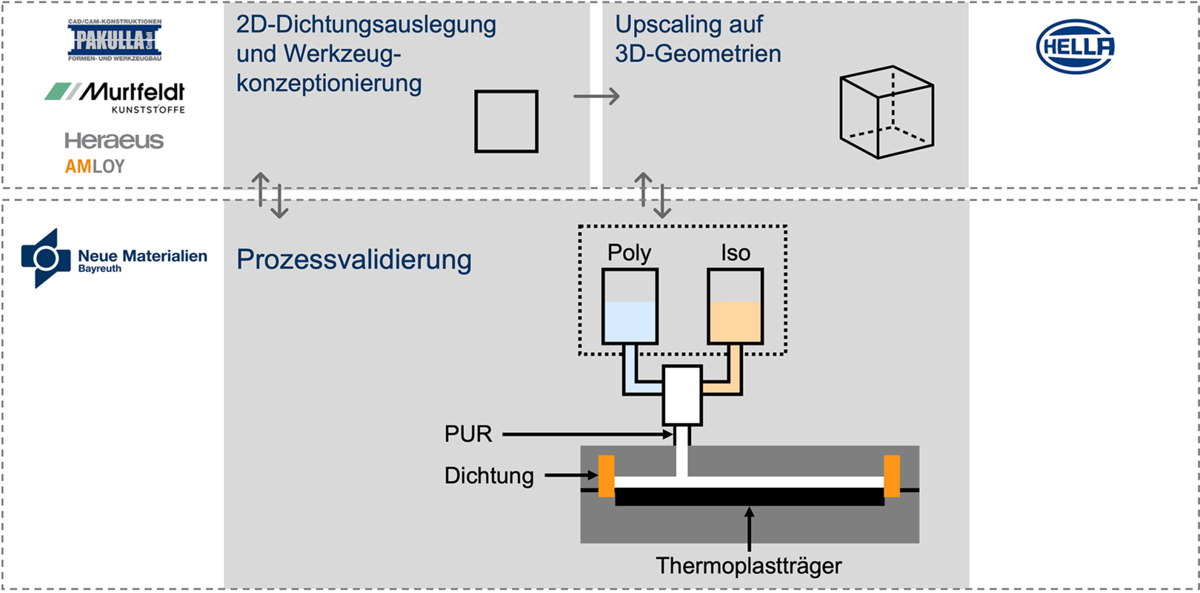
The targeted use of flexible seals elevates the surface finishing in the injection molding process to a new level – without a visible sealing edge and with maximum design freedom.


Motivation
Avoidance of a Visible Sealing Edge
The polyurethane In-Mold Coating (PUR-IMC) process is used to produce high-quality Class-A surfaces. Due to the low viscosity of the PUR system (10–100 mPa·s), conventional seals are inadequate. Currently visible sealing edges on the component surface are optically undesirable and require reworking.

Solution Approach
Flexible Seals
The goal is to develop a flexible sealing system that allows for cavity-flush sealing without a visible sealing edge. Novel materials such as amorphous metals and high-temperature plastics will be used, which reliably seal even with complex geometries.
Approach
Development of Flexible Sealing Systems for Use in Polyurethane In-Mold Coating
- Identification of suitable sealing materials (amorphous metals, high-temperature thermoplastics)
- Development of new sealing geometries and integration into tool inserts
- Simulations and pressure tests to evaluate sealing effectiveness and lifespan
- Process adjustment to avoid visible sealing edges
- Validation of the 2D geometry based on a 3D test component
- Development of a guideline for selecting suitable sealing elements depending on component geometry and surface requirements
Project sponsor: Federal Ministry for Economic Affairs and Energy (BMWE), Central Innovation Program for SMEs (ZIM) | Funding code: 16KN097323
Partners: Pakulla GmbH, Murtfeldt Kunststoffe GmbH & Co. KG, Heraeus AMLOY Technologies GmbH, Hella Interior Lighting Systems GmbH