
1
Case StudyFDM-MAR
Crack-free and low-stress components made from non-weldable alloys
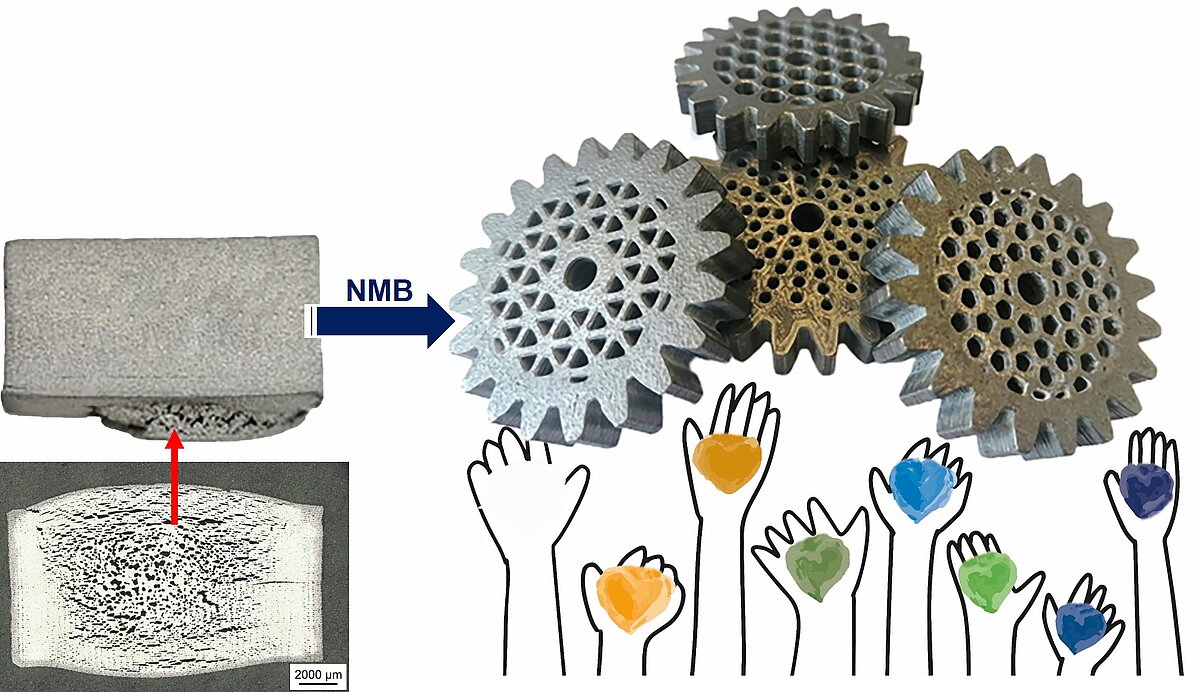
Non-weldable alloys are characterized by excellent properties in terms of hardness, wear resistance, and thermomechanical properties. They are of great importance in many industrial applications. However, during additive manufacturing processes (AM), they are particularly susceptible to crack formation. NMB has developed the Fused Filament Fabrication (FFF) process to produce crack-free and low-stress components from non-weldable alloys.

Approach

Motivation
Avoiding Crack Formation
Non-weldable alloys offer excellent mechanical and thermal properties – ideal for demanding applications. However, manufacturing these materials using additive manufacturing processes (AM) is a challenge: during the process, cracks can occur due to strong temperature differences and stresses. These cracks impair the quality and performance of the components. Therefore, it has been difficult to reliably manufacture high-quality components from these alloys using AM.

Solution Approach
Sinter-based AM Processes
At NMB, sinter-based AM processes have been further developed to produce crack-free components from non-weldable alloys. This is possible because the filaments are printed at low temperatures below 200 °C by mixing metal powders with polymeric binders. These low temperatures prevent thermal gradients, thus avoiding crack formation.
Approach
Sinter-based additive manufacturing processes for crack-free and difficult-to-process materials
- Further development of the Fused Filament Fabrication (FFF) process for the production of complex and high-quality components
The further development of the Fused Filament Fabrication (FFF) process aims to significantly enhance the manufacturing of complex and high-quality components through improved printing parameters, optimized nozzle geometries, and novel filament materials. This not only allows for higher dimensional accuracy and better mechanical properties but also enables the efficient and reproducible production of functionally integrated structures. - Optimization of the manufacturing process specifically for difficult-to-process materials with high requirements
In the development of the manufacturing process for difficult-to-process materials with high requirements, process parameters such as temperature control and cooling strategies are specifically adjusted to minimize material deformations and stresses. With specialized plant technology and intelligent process monitoring, even demanding materials such as high-temperature alloys or corrosion-resistant metals can be processed efficiently and reliably. - Development of a seamless process chain that efficiently connects additive manufacturing and downstream sintering processes
To optimize the production of complex components with high quality requirements, a seamless process chain is being developed that efficiently connects additive manufacturing and downstream sintering processes. This integration enables the production of crack-free and stress-free components, significantly improving the mechanical properties of the end products.
Project sponsor: Federal Ministry for Economic Affairs and Energy (BMWE), Central Innovation Program for SMEs (ZIM) | Funding code: KK5027501SH0
Partner: Peter Würtele