

1
Case StudyInduLAAM
Industrial Scale Manufacturing of Customized Large Components Using Large Area Additive Manufacturing
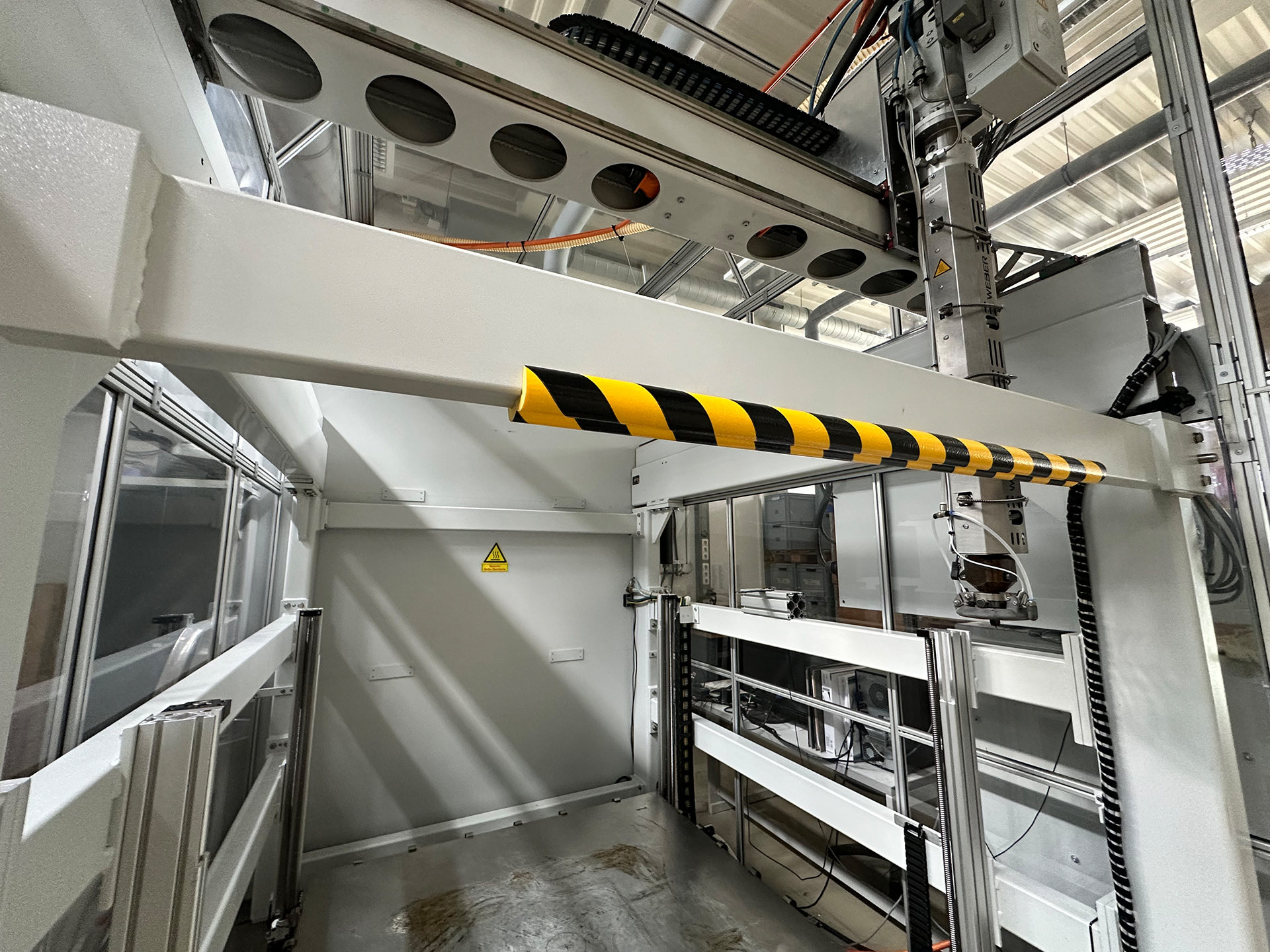
InduLAAM develops a modular 3D printing platform for direct extrusion of polymer granulates for the economical production of large-format components. A test facility with a build volume of 1.5 × 1.5 × 1 m³, variable nozzle geometries, and throughput of up to 35 kg/h forms the basis. By precisely coordinating material, process, and extrusion technology, a scalable, precise, and industrial-grade Large Area Additive Manufacturing (LAAM) system is created.

Motivation
Economic qualification of the extrusion-based Large Area Additive Manufacturing (LAAM) process)

Approach
InduLAAM provides the proof of concept: Large-format 3D printing is scalable, process-safe, and ready for industrial use

Motivation
Economic Qualification of the Extrusion-Based LAAM Process
Large-volume 3D printing offers enormous potential for industries such as automotive, architecture, mechanical engineering, and trade fair construction. In particular, when manufacturing individualized, large-format components, costs, material usage, and production times can be significantly reduced. However, flexible systems that combine high throughput rates, large build volumes, and precise process control are still lacking for industrial implementation.
Especially in the processing of polymer granulates through direct extrusion, the close coupling of material properties, process parameters, and printing technology is crucial for component quality. Standardized solutions quickly reach their limits here. To meet the requirements for material diversity, structural strength, and dimensional accuracy, an application-oriented in-house development is necessary that specifically integrates material, nozzle and extrusion technology, and control.

Solution Approach
Large Format Printers for Direct Extrusion of Different Polymer Granulates
The InduLAAM project is developing a modular, large-volume 3D printing platform based on the direct extrusion of polymer granulates, specifically tailored to industrial requirements. The central element is the development of a flexible test facility with a build volume of 1.5 × 1.5 × 1 m³, which allows for variable nozzle geometries and throughput rates of up to 35 kg/h. This enables the production of both highly precise and large-volume components under realistic conditions.
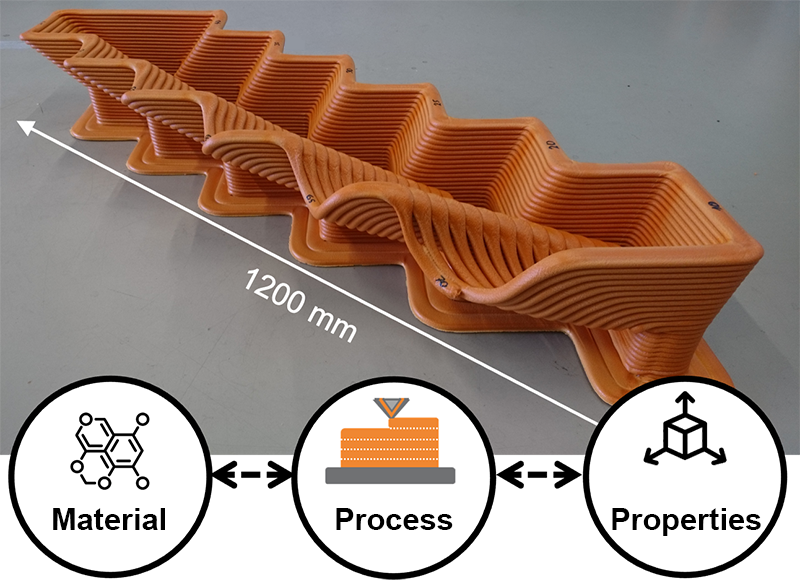
The focus is on the precise coordination of material properties, process parameters, and extrusion technology. Various nozzle geometries and material systems are systematically analyzed regarding their processability, component quality, and structural properties. Additionally, the relationship between structure, process control, and resulting component properties is investigated to enable informed process optimization.
This integrative approach aims to create a scalable, industry-compatible solution that not only allows for high material throughput but also enables precise and reproducible manufacturing of complex large components.
Approach
Technological Setup and Process Development for Large-Volume LAAM Manufacturing
- Development and technical implementation of a functional LAAM test facility
Establishment of a flexible test stand with a build volume of 1.5 × 1.5 × 1 m³ for validating large-volume printing processes - Investigation and selection of suitable nozzle configurations
Testing variable nozzle diameters (1–14 mm) and geometries to adapt to different requirements for precision and throughput - Scaling of material throughput
Development of a stable extrusion process with a throughput of up to 20 kg/h to increase manufacturing efficiency - Optimization of material, process parameters, and extrusion technology
Adjustment of polymer granulates and process control to ensure high component quality - Analysis of structure-process-property relationships
Systematic investigation of the relationship between material structure, process parameters, and resulting component properties for targeted process control
Project sponsor: Bavarian State Ministry of Economic Affairs, Regional Development and Energy | Funding code: NW-1807-0003
Partner: REHAU AG + Co